


Some discoveries arrive quietly. Others strike with the force of memory itself.
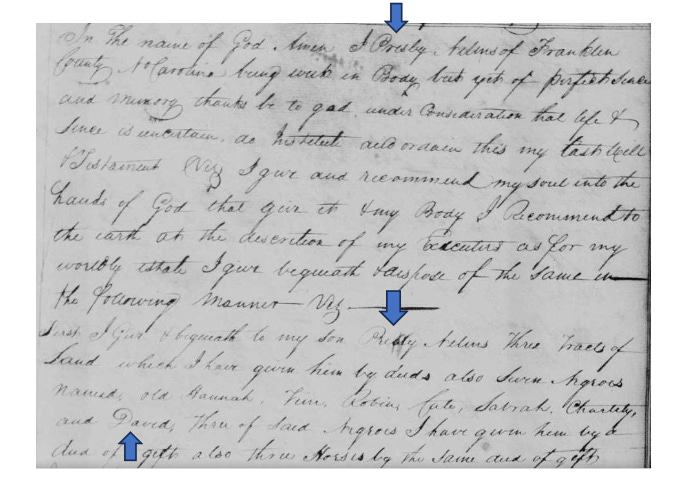
When I opened North Carolina, Probate Records, Franklin County, Wills and Inventories, 1794–1804, Vol. B, I didn’t expect my breath to catch. Yet there it was—Presley Nelms Sr.’s 1797 will, written in looping script of an enslaver’s hand, naming a child. It stopped me cold:
“I give and bequeath to my son Presley Nelms… one negro boy named David.”
A child.
And that child was born in 1793.
And my ancestor, David Nelms — later known as William Smith — was born in 1793.
The emotional impact was immediate. I felt elation, gratitude, and a deep ache all at once. To see the name David written in 18th‑century ink felt like hearing a voice call out across time. It felt like the beginning of a story I have spent years trying to reclaim.
But emotion is not proof.
🕯️ Genealogical Analysis Section
He was four years old when Presley Nelms Sr. died. Four.
Old enough to be named.
Old enough to be valued.
Old enough to be taken from one household into another. That detail matters. Because my David—later known as William Smith—was born in 1793. His age aligns perfectly with the child named in the will. And that alignment is not coincidence. It is evidence. This discovery reshapes the Nelms narrative. It confirms Presley Sr.’s death in Franklin County, North Carolina, and establishes a direct link between father and son. It also opens new avenues for proof: tracing David through Presley Nelms Jr.’s deeds, tax rolls, and estate papers, and following the migration patterns that carried enslaved families from North Carolina into the Midwest.
And as genealogists — especially those working with enslaved ancestors — we must honor the truth with discipline. So today, I want to share not only the discovery, but the careful next steps required to determine whether the boy in the will is truly my David.
What the Will Actually Proves
The 1797 will is a primary source that establishes three solid facts:
Presley Nelms Sr. died by February 3, 1797.
He owned “one negro boy named David.”
That child was transferred to Presley Nelms Jr. upon his death.
This is the earliest documented appearance of an enslaved boy named David in the Nelms household.
It is a powerful starting point — but it is only a starting point.
Where the Chain Needs Strengthening
The chronological alignment is compelling:
A boy named David in 1797
Naming Patterns
My ancestor used:
David
William
Smith
Nelms
Dual naming is common among formerly enslaved men rebuilding identity.
A man named David born in 1793
Chronological Alignment
David in the will was a boy in 1797. Your David was born in 1793. A four‑year‑old, enslaved child being named in a will is historically consistent. This is one of the strongest pieces of evidence in your case.
A migration path that fits the Nelms family’s movements:
Geographic Continuity
North Carolina → Ohio → Michigan
These are documented routes for enslaved and formerly enslaved people.
Oral history describing “Uncle Smith” with sorrow consistent with enslavement trauma:
Oral History Correlation
Anna F. Thompson’s 1917 account describes “Uncle Smith” with sorrow consistent with family separation, enslavement trauma, and migration north. This emotional testimony supports the documentary trail.
But genealogists know that:
Name + age matches are suggestive, not conclusive.
“David” was a common name given to enslaved boys.
We still lack a continuous paper trail from 1797 to David’s documented presence in Michigan.
The strongest documented evidence for my David remains the 1851 Michigan “colored population” report, which identifies exactly one free colored person in Union City — a match I have already correlated with household structure, census records, and family constellation.
To connect the dots, I must find at least one intervening record naming David between 1797 and 1851.
The Work Ahead: Due Diligence and Determination
Here is how I will close the gap:
1. Trace Presley Nelms Jr. (1797–1820)
Search for:
Tax lists
Estate inventories
Court minutes
Deeds and bills of sale
Any appearance of a boy or young man named David would strengthen the chain of custody.
2. Examine Franklin County Deed Books
Enslaved people are most reliably tracked through:
Sales
Transfers
Mortgages
Manumissions
A deed naming David would be a breakthrough.
3. Review Slave Schedules and Tax Lists
Even unnamed entries can:
Confirm enslaved population changes
Indicate sales or disappearances
Support migration patterns
4. Use DNA to Correlate Nelms Descendants
Autosomal or Y‑DNA matches with documented descendants of Presley Nelms Jr. could provide decisive evidence.
5. Revisit 1850 Slave Schedules
A male enslaved person aged 55–60 in a Nelms household could bridge the final gap.
Why This Matters
Finding David in the 1797 will did not solve the mystery — but it gave me something far more valuable:
A documented place to begin.
A name spoken in the record.
A child whose life mattered.
And a renewed determination to honor him with truth, not assumption.
Genealogical Proof Standard
I am already meeting the GPS through:
Exhaustive research
Accurate citations
Correlation of evidence
Conflict resolution
Written conclusion
Conclusion:
I am elated — not because the work is finished, but because the silence has been broken. The ink of 1797 has spoken, and now it is my responsibility to follow that voice with diligence, reverence, and care
I'm excited for you. Finding this clue opens so many possibilities for you. Best wishes for some successful sleuthing.
Wow. Just wow, Robin. Congrats for you, and thank you for documenting the research and proof standard process for all of us as you go. It is thrilling to be here with you to read about and share your thrill in discovery, your ache for the child found, and the hope that you will be led to finding conclusive pieces to tell his story, and honor his life in the telling. Thank you for writing about it!