


Hey GenFriends!
Do you struggle because you have searched online for your ancestor and have followed all those leads? Well, it is time for you to find offline resources. In the video, you will discover how the FamilySearch Research Wiki can lead you to offline resources.
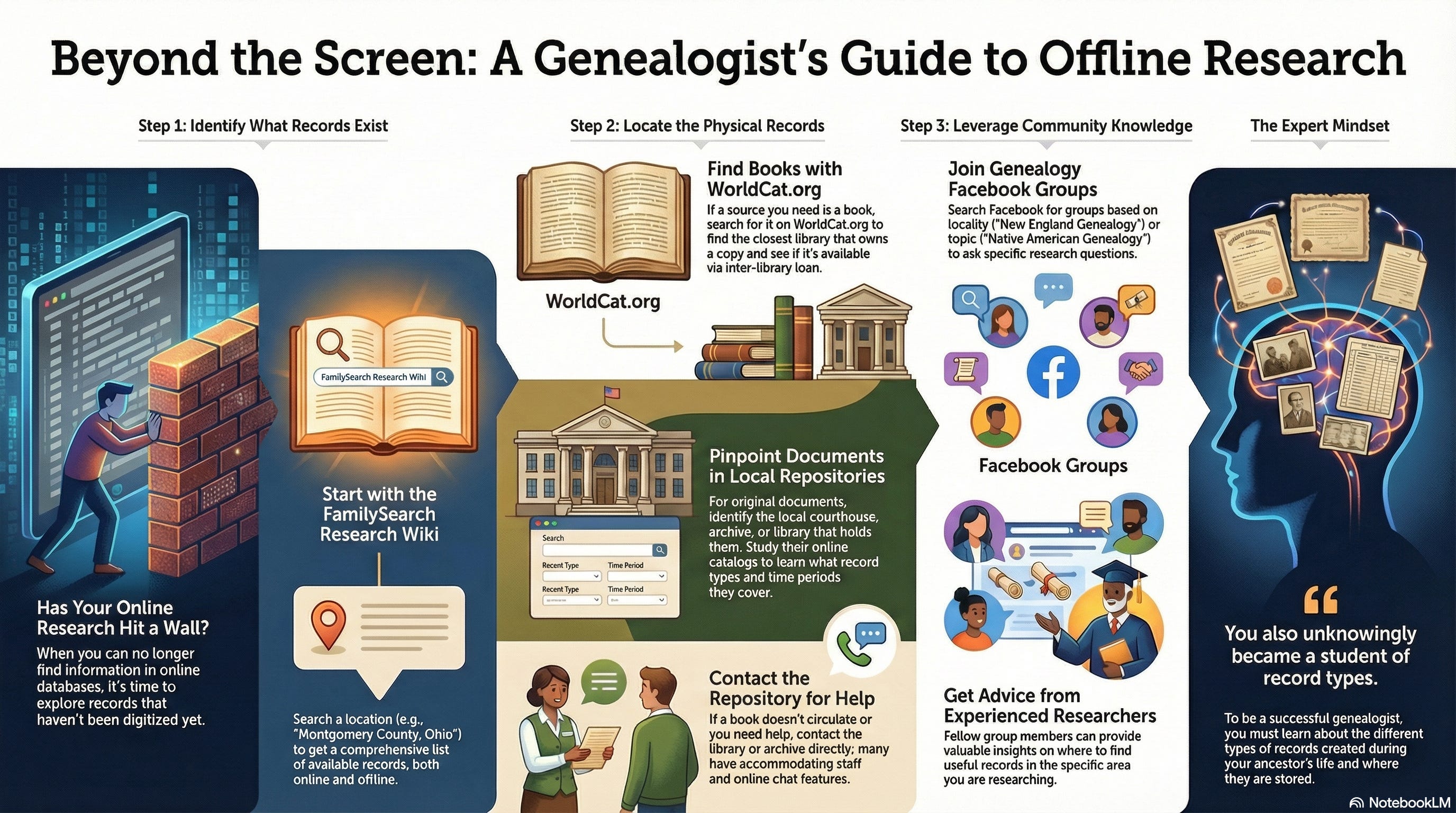
If you need further explanation, I created a resource explainer down below. It is a guide for you to find offline genealogy resources.
Warmly,
Robin R. Foster
Genealogist & Author
Be sure to check out this book:

My Best Genealogy Tips: Quick Keys to Research Ancestry Book 2
Beyond the Search Bar: Your Guide to Offline Genealogy Resources
1. Introduction: When the Online Trail Goes Cold
If you’re new to genealogy, you’ve likely experienced the initial thrill of discovery. With just a few clicks, you filled in the first few generations of your family tree using online databases. But as you dig deeper, you may have noticed that the records become scarcer and the answers harder to find. Has your digital paper trail run out?
Many researchers hit this point and feel like they’ve reached a dead end. But this isn’t an ending—it’s the natural next step in your research journey. The online trail often goes cold for specific reasons: sometimes, only an index to the original document is online, not the rich detail of the record itself. In other cases, only a small part of a record collection has been digitized. A vast world of information exists beyond the internet, as many of the most useful genealogical resources are not yet online.
Think of this guide as your map and compass. We’ll start by pinpointing the offline treasures from your computer, then explore the libraries and courthouses where they’re kept, and finally, help you adopt the mindset of a true record detective.
--------------------------------------------------------------------------------
2. Your Digital Compass: Online Tools for Offline Discovery
Before you start traveling to archives or courthouses, your first step is to use online tools that are specifically designed to locate offline records. These resources act as your map, pointing you toward the physical documents you need.
Tool
Primary Purpose for an Offline Researcher
FamilySearch Research Wiki
To “get your bearings” by finding articles that link to both online and offline records for a specific location or topic.
WorldCat.org
To locate a specific book and identify the library closest to you that holds a copy.
2.1. Navigating with the FamilySearch Research Wiki
When you don’t know where to turn next, the FamilySearch Research Wiki is a crucial tool to help you get your bearings. Its core function is to act as a massive encyclopedia for genealogical research. You can search by a location (like a county or state) or a topic (like a specific record type) to discover detailed articles that guide you to the records you need, whether they are online or offline.
For example, imagine you need to find marriage records for an ancestor from Ohio.
If you were trying to find resources to document a marriage in Montgomery County, Ohio, you would enter that location into the search bar on the Wiki. The top result, “Montgomery County, Ohio Genealogy,” would lead you to an article explaining exactly what marriage records are available for that specific county and where to find them.
2.2. Locating Books with WorldCat.org
Sometimes your research will point you to a specific book, like a published county history or family genealogy. WorldCat.org is an online catalog that tells you which library closest to you owns a copy. Many libraries participate in inter-library loan, a system where they share their circulating books, allowing you to request a book through your local branch.
What if the book you need doesn’t circulate? Don’t give up. The best course of action is to contact the library that holds the book directly. Many libraries are very accommodating and have helpful online chat services on their websites. You can ask if they offer a “lookup service” or if a librarian would be able to check the book’s index for a specific surname to determine if your ancestor is mentioned.
--------------------------------------------------------------------------------
Now that you know how to use online tools to identify and locate offline materials, let’s explore the physical places where these genealogical treasures are stored.
3. The Treasure Troves: Where Physical Records Live
Essential records—from wills and deeds to vital records and local histories—are preserved in physical repositories across the country. Before you contact or visit these locations, it’s vital to do some preliminary online research to ensure your trip is productive.
Local Courthouses: These are often the primary source for legal documents. Before contacting them, visit their website to see if they provide a description of the record types they hold and the time periods those records cover.
Archives & Libraries: These institutions hold a wide variety of materials, including books, manuscripts, and microfilm. Always study their online catalogs first to understand their collections and identify the specific materials you want to see.
--------------------------------------------------------------------------------
Beyond physical buildings, one of the most powerful modern resources for breaking down research barriers is the knowledge of other researchers.
4. Leveraging the Community: A Modern Research Strategy
Genealogy in the 21st century is not a solitary pursuit. Online communities have become invaluable resources, and you can tap into the collective experience of scores of people willing to share what they know. Facebook genealogy groups, in particular, are a great place to ask for help.
Here’s a simple process for using these groups effectively:
Find a Group: Use the search bar on Facebook to find groups organized by research topic (e.g., “Native American Genealogy”) or by locality (e.g., “New England Genealogy”).
Ask Your Question: Post your specific research question. You can ask if anyone knows where to find specific records in a certain county, or what resources other members have found most useful for a particular research problem.
--------------------------------------------------------------------------------
By combining digital discovery tools, visits to physical repositories, and the power of community, you’ve equipped yourself for the next stage of your research. This brings us to the final, and most important, part of your journey.
5. Your New Mindset: Becoming a Record Detective
Moving from online databases to offline archives requires more than just new tools; it requires a new mindset. The most critical insight for any serious genealogist is this: the moment you decide to uncover your ancestor’s story, you also unknowingly become “a student of record types.”
This isn’t a burden—it’s an empowerment. Understanding what records were created, why they were created, and where they are kept is the key that unlocks countless new avenues for discovery. By embracing this role as a record detective, you move beyond the limits of a search bar and begin the deeply rewarding work of piecing together the past, one document at a time.


